How Wholesale Custom Fragrance Projects Work, and Where the Money Goes
In a wholesale custom fragrance project, the unit price is the last number to become stable and the first one buyers ask about. The project actually has five cost stages — development, sampling, packaging tooling, bulk production and logistics — and only bulk production scales meaningfully with volume. Budgeting for the whole sequence rather than the unit price is what separates projects that land on plan from projects that get renegotiated halfway through.
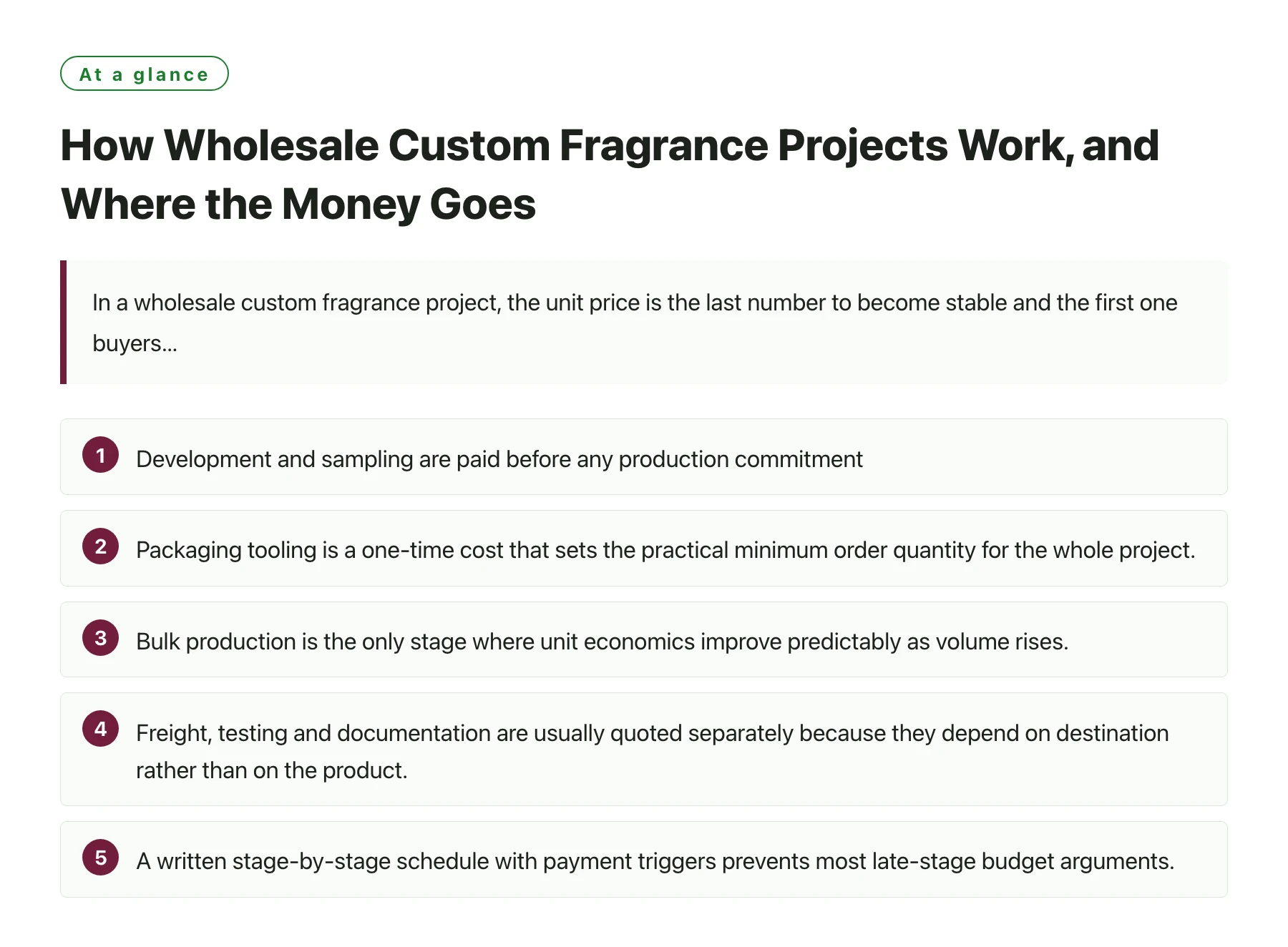
Key takeaways
- Development and sampling are paid before any production commitment, and they do not reduce when volume increases.
- Packaging tooling is a one-time cost that sets the practical minimum order quantity for the whole project.
- Bulk production is the only stage where unit economics improve predictably as volume rises.
- Freight, testing and documentation are usually quoted separately because they depend on destination rather than on the product.
- A written stage-by-stage schedule with payment triggers prevents most late-stage budget arguments.
Wholesale enquiries usually arrive as a single question: what does it cost per unit? The honest answer depends on decisions that have not been made yet, including the formula, the bottle and the order quantity.
Rather than waiting for a perfect answer, it helps to understand the structure of the spend. A fragrance project consumes money in a predictable sequence, and each stage has a different relationship with volume.
This breakdown sets out those stages, what drives each one, and the points at which a project can be paused without wasting what has already been paid.
The five cost stages of a wholesale fragrance project
| Stage | What it covers | How it responds to volume | Typical payment trigger |
|---|---|---|---|
| Development brief and direction | Translating a brand idea into a workable olfactory direction and an initial formula | Barely changes with volume, since the work is intellectual rather than material | On brief approval, before the first sample |
| Sampling and revision rounds | Trial blends, wear testing and the revision rounds included in the agreement | Fixed within the agreed number of rounds; extra rounds are charged separately | Per sample set or per revision round |
| Packaging and tooling | Bottle moulds, cap tools, printing plates and carton dies | One-time cost recovered across the run, so a larger order carries less per unit | On tooling release, before production scheduling |
| Bulk production | Materials, batching, filling, crimping, labelling and packing | Unit cost falls as fixed setup is spread across more pieces, then flattens | Deposit on order, balance before shipment |
| Testing, documentation and freight | Third-party testing, transport paperwork, customs and shipping | Depends on destination and shipment size rather than on order value | At booking, usually as a separate schedule |
The third column explains why wholesale pricing conversations go in circles. Two thirds of the spend is fixed or semi-fixed, so a buyer asking for a lower unit price at a small volume is really asking the supplier to absorb tooling that the order cannot carry.
What makes a wholesale project different from a retail one
Wholesale fragrance work is usually distinguished by volume commitment, by the number of intermediaries between factory and shelf, and by how much of the branding the buyer controls.
The commitment is larger and earlier
A wholesale order typically asks for a firm quantity, sometimes with a forecast for subsequent runs. That commitment is what allows the factory to buy materials at a better price and to schedule line time.
In exchange, buyers usually get better unit economics and more certainty on delivery. The trade-off is that changes after the order is placed become expensive, because materials have been purchased against the original specification.
Channel shapes the specification
A scent destined for a discount chain, a pharmacy group and a specialty retailer will be specified differently even if the brief sounds identical. Package size, concentration, closure type and carton quality all follow the channel.
This is one reason a specification should name the channel explicitly. Market research houses that track beauty and personal care regularly report how fragrance interest and spending shift between categories and price tiers [1], and those shifts show up first in what retail buyers are willing to list.
Branding control is negotiated, not assumed
In wholesale arrangements the buyer may control the brand while the factory controls the formula, or the arrangement may include licensing of a scent for a defined channel and period.
Both are workable, but the split needs to be written down before samples are approved. It is the single question most likely to be raised again two years later when the brand has grown.
The stage where wholesale projects most often go wrong is not production; it is the gap between sampling and tooling. The scent is approved, the bottle design is finalised, and only then does anyone price the mould. If the tooling cost or the resulting minimum quantity does not fit the budget, the brand either accepts a much larger first order or restarts the packaging work. Price the tooling before the design is locked, not after.
Running the project so the budget holds
- Write the brief once, in fullProduct, channel, markets, packaging list, quantity ladder and launch date on a single page that both sides work from.
- Ask for the stage schedule with pricesRequest each stage with its cost, its duration and its payment trigger, rather than one blended figure.
- Approve the tooling cost before the designGet mould and plate prices while the packaging concept is still flexible, since that is when they can still be changed cheaply.
- Set the revision limit deliberatelyAgree how many sampling rounds are included and what an extra round costs, so the development stage cannot quietly expand.
- Confirm the documentation listDecide which certificates, safety documents and batch records travel with each shipment, and who prepares them.
- Keep a reference sample locked awayRetain the approved sample under proper conditions so bulk batches can be compared against something physical rather than a memory.
Reading a wholesale quotation properly
Once a quotation arrives, the fastest way to compare it against another is to break it into the same five stages. Numbers that cannot be assigned to a stage are usually the ones that will change.
For a stage-by-stage view of the same sequence, see how wholesale custom fragrance projects work, which walks through the development flow in order.
Check what the unit price includes
A unit price may cover bulk juice only, juice plus filled bottle, or the complete packed unit. Each is a legitimate quotation and they differ by a large factor.
Ask for the price at the packed-unit level even if you also want the bulk figure, because that is the number that connects to your landed cost.
Look for the assumptions page
Quotations with a stated assumption list are easier to trust than those without, because the assumptions are exactly what will change if the project shifts.
Common assumptions include order quantity, payment terms, Incoterms, packaging specification and the number of revision rounds included.
Decide what happens if volume falls short
Forecast shortfalls are common, and the remedy depends on whether materials were bought specifically for the order. Agree in advance whether unused components are stored, invoiced or written off, and ask for material commitments to be confirmed in writing at order stage. Guangzhou, where manufacturers such as Xuelei are based, is one of the clusters where this kind of wholesale work is routine, so these terms are usually open to negotiation.
Sources
- Mintel Press Centre —— Mintel's press releases on consumer and beauty market research, including fragrance and personal care trend reporting.
Frequently asked questions
Why does the unit price change between quotations for the same product?
Usually because the quotations cover different scopes. One may price bulk juice, another the filled bottle, and a third the packed carton. Once each quote is broken into development, sampling, tooling, production and logistics, the gap is normally explained by scope rather than by margin.
Does a larger wholesale order always reduce the unit price?
It reduces the share of fixed costs per unit, which is a real saving, but the effect flattens once setup and tooling are fully spread. Beyond that point, volume savings come from material purchasing rather than from the production process itself.
At which stage can I stop a wholesale project without losing everything?
After sampling and before tooling release is the cheapest stopping point. Development money is spent, but no moulds or plates exist and no materials have been committed. After tooling, most of the one-time cost is already committed.
Who pays for packaging tooling in a wholesale arrangement?
It is negotiable and depends on who owns the design. If the brand owns the bottle and carton design, it usually pays for the tooling and keeps it. If the brand is choosing from the factory's existing packaging range, tooling may not be needed at all.
How should freight be budgeted for a fragrance order?
Treat it as a separate schedule based on destination, shipment size and the classification of the goods. Ask for an estimate at the quotation stage and a firm figure closer to shipment, since fragrance classification and transport rules affect both cost and paperwork.