What to Tell a Customer Who Asks When They'll Have 0.05 BTC
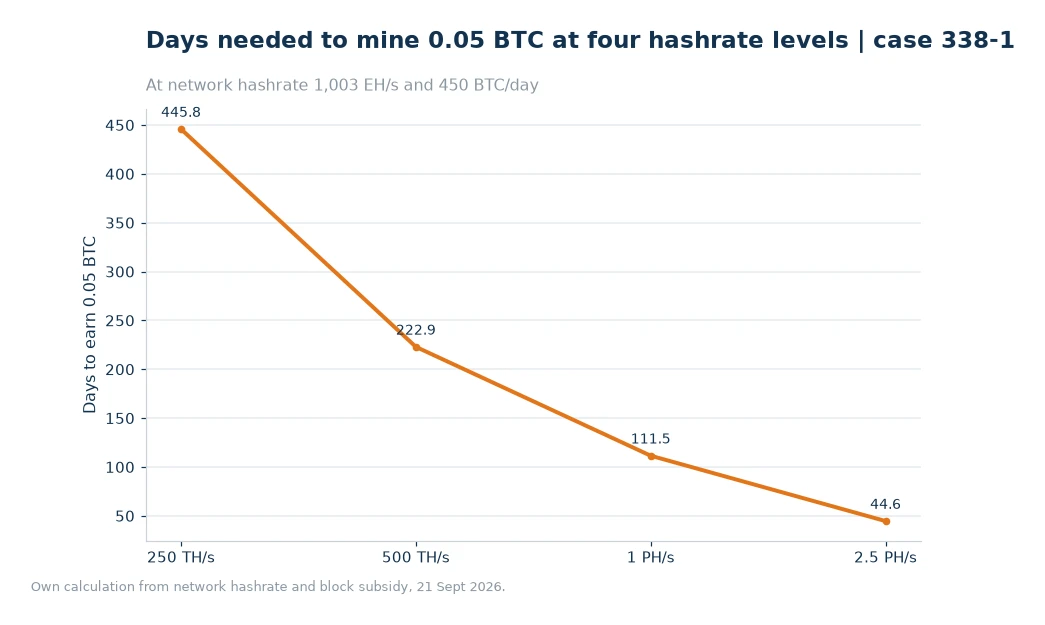
The awkward moment in a mining hardware sale is not the price. It is the question that follows: "so when do I have 0.05 BTC?" At 250 TH/s the honest answer is about 445.8 days at the 21 Sept 2026 network figures; at 2.5 PH/s it is 44.6 days. A seller who quotes the second number while shipping the first machine has created a complaint with a delivery date.
Key takeaways
- Quote days, not adjectives: 445.8 days at 250 TH/s, 222.9 at 500 TH/s, 111.5 at 1 PH/s, 44.6 at 2.5 PH/s.
- 0.05 BTC is worth $4,234.60 at $84,692, so the timeline has a cash equivalent the customer can weigh.
- State the network total and the date beside every quote, because both inputs move.
- Explain Pool Luck before the first payout, not after the first quiet week.
The question behind the sales conversation
Customers rarely ask about hashrate in plain terms. They ask what they will have, and when. That is a reasonable question and it has a computable answer, provided both parties agree on the machine's effective hashrate and the network conditions. The seller's job is to put those two numbers on the same page as the price.
The failure mode is a quote built on the best case. A demonstration unit on a cool bench, a network total from six months ago and a coin price from a good week will produce a timeline nobody can meet. The customer remembers the date, not the assumptions, and the assumptions are what went wrong.
Quote a range and show the inputs
A single number invites an argument about precision that the underlying arithmetic cannot support. A range does the opposite: it communicates that the answer depends on things outside the seller's control. Give a central figure and a slower figure, and name the causes of the difference — uptime, difficulty drift, a machine that throttles in summer.
Then show the division. Three lines are enough: the network's daily output per terahash, the customer's hashrate, and the target divided by the result. A customer who can redo the sum is a customer who can also see when a later statement is in line with the plan, which removes most of the suspicion that support desks spend their time on.
It helps to send the work, not just the conclusion. A screenshot of the arithmetic is worth more than a sentence, because the customer can change one number and see what happens if they run the machine eight hours a day instead of twenty-four. That exercise is usually the moment the purchase becomes real to them, and it is better to have it before the invoice than after.
There is also a commercial argument for the range. A customer who was told 446 days and receives a statement that tracks 460 days is not surprised; a customer who was told "about a year" and receives the same statement feels misled. The difference is entirely in how the expectation was set, not in the outcome.
Four products, four timelines
The table translates a product range into months and into a yearly rate, because a customer comparing two machines needs the difference in a unit they already understand. Months are friendlier than days; batches per year answers the follow-up question about frequency.
| Class | Hashrate | Days to 0.05 BTC | Months | Batches per year |
|---|---|---|---|---|
| Entry | 250 TH/s | 445.8 | 14.6 | 0.82 |
| Mid | 500 TH/s | 222.9 | 7.3 | 1.64 |
| High | 1 PH/s | 111.5 | 3.7 | 3.27 |
| Farm | 2.5 PH/s | 44.6 | 1.5 | 8.18 |
Worked example
Here is a quote you could hand to a customer, built in seven lines and correct at the date shown.
- Each terahash earns 450 ÷ 1,003,000,000, which is 0.0000004486 BTC a day.
- Entry machine at 250 TH/s: 0.00011215 BTC a day.
- Target divided by rate: 0.05 ÷ 0.00011215 = 445.8 days.
- In months at 30.4 days: 445.8 ÷ 30.4 = 14.7, which rounds to the 14.6 in the table at 30.5 days.
- Batches per year: 365 ÷ 445.8 = 0.82, so the entry machine does not quite complete one batch a year.
- Cash value of the target: 0.05 × 84,692 = $4,234.60.
- The 2.5 PH/s machine is ten times the entry size, so its 44.6 days is the same division with a decimal point moved.
Where Pool Luck enters a support ticket
A customer on PPLNS who expects a smooth daily figure will eventually see a week that does not match the quote. That is Pool Luck: the pool's block finds over the last five difficulty rounds differ from expectation, and the miner's slice follows what was found. It is not a fault and it is not the seller's timeline being wrong, but it looks like both if nobody explained it beforehand.
The cleanest way to set expectations is to show the ViaBTC Pool Hashrate figure at the point of sale and explain that a larger pool share means more frequent block finds, which shortens the window in which a payout settles toward its average. Customers who understand that stop reading a quiet week as a broken machine.
The sentence that prevents most complaints
"At today's network total, this machine reaches 0.05 BTC in about 446 days, assuming it runs continuously and the difficulty stays close to today's level." Every clause in that sentence is doing work. Today's network total gives it a date. Continuously names the uptime assumption. Difficulty stays close flags the variable that will move.
Compare it with "you should see 0.05 BTC in about a year", which is shorter, warmer and unverifiable. The longer sentence is less pleasant to read and much less likely to produce an angry email eleven months later, when the customer has a statement that shows 0.041 BTC and a memory of a promise.
Train whoever answers the phone to use the same sentence. Two different explanations of the same timeline, given by two people in the same week, undo the care that went into the quote. A one-page script with the four hashrates and the three assumptions is enough, and it doubles as the document a new salesperson reads on their first morning.
Frequently asked questions
How long should a seller say 0.05 BTC takes?
Give the figure for the machine being sold: 445.8 days at 250 TH/s, 222.9 at 500 TH/s or 44.6 at 2.5 PH/s, with the network total and the date attached to the quote.
Why do two customers with the same machine get different results?
Uptime, ambient temperature and the pool's Pool Luck all differ, and the first two change the delivered share rate while the third changes how a PPLNS payout is distributed across a window.
Should the quote use the gross or net figure?
Net, because the customer receives the amount after the listed 4% on the block-reward component; at 250 TH/s that is a small deduction but it belongs in the number you write down.
Put the assumption in the quote
Send the quote with three lines underneath: the date the figures were read, the network hashrate used, and the words "assumes continuous operation". That is a paragraph a customer can keep, and it turns a future disagreement into a shared reference. It also protects the seller from being asked to defend a number that was never theirs.
For customers weighing a hosted arrangement instead of a purchase, the Mining Companies and Miner Hosting listings show the categories of provider, and the fee schedule gives the listed rates that belong in any payout quote. Neither replaces the arithmetic above, but both answer the question the customer asks next.
Sources: ViaBTC pricing, pool state and companies pages; network figures read 21 Sept 2026 — hashrate about 1,003 EH/s, difficulty 132.76 T, 3.125 BTC per block, 144 blocks a day, BTC $84,692. Published 24 Oct 2026. Timelines assume constant difficulty and no downtime[1].