Questions Importers Can Ask About Planning packaging for construction materials
Construction materials often travel in mixed loads and face repeated lifting, stacking, moisture, vibration, and site handling. Packaging should protect the actual product, preserve identification, and support safe unloading and installation. Buyers should translate route conditions and receiving constraints into a written pack specification, then confirm the production package through samples and shipment checks.
Key takeaways
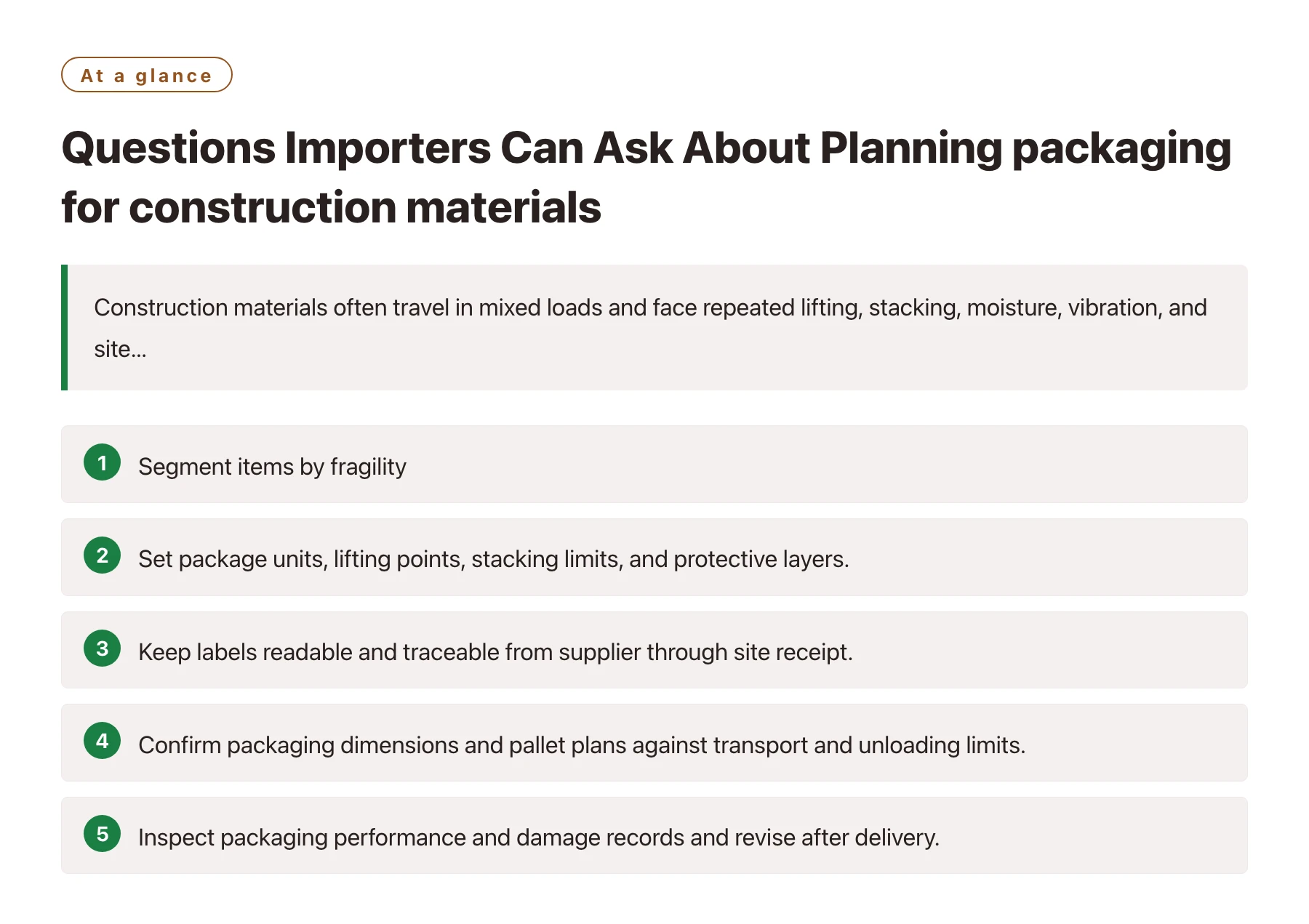
- Segment items by fragility, shape, weight, finish, and moisture sensitivity.
- Set package units, lifting points, stacking limits, and protective layers.
- Keep labels readable and traceable from supplier through site receipt.
- Confirm packaging dimensions and pallet plans against transport and unloading limits.
- Inspect packaging performance and damage records and revise after delivery.
Packaging is part of the delivered product: it affects protection, handling cost, storage, identification, and site distribution.
1. Classify the material and its damage modes
Group products by form and risk: tile, stone, glass, sheet, profiles, fittings, bags, sanitary products, or prefabricated assemblies. Record weight, dimensions, finish, corners, protrusions, breakability, sensitivity to moisture, and whether items are stacked or bundled.
Map damage that matters, such as chipping, scratches, bending, warping, cracking, contamination, corrosion, broken fittings, or loss of surface protection. Consider where it may occur: factory movement, loading, transshipment, warehouse storage, unloading, or on-site distribution.
2. Define the unit of packaging and count
Specify pieces per inner pack, cartons per pallet, bundle quantity, mixed-SKU rules, and total package count. Decide whether each package contains one product code, finish, size, or lot. State tolerances for count and how samples or spare parts are identified.
Align package configuration with purchase quantities and site installation sequence. A pallet that combines several rooms or finishes may be efficient to ship but difficult to receive and distribute. Keep the packing list structure consistent with package marks and buyer inventory records.
3. Select protective layers and separators
Choose separators, corner guards, foam, paper, sleeves, wrap, edge protectors, or crating according to contact points and surface finish. Define where protection must remain until installation and how it can be removed without damage. Check for abrasion between parts during vibration or movement.
For fragile flat products, evaluate orientation, support, cushioning, and edge protection. For long profiles, consider bending, end damage, and support spacing. For bagged or granular products, consider puncture, seam integrity, stacking, and moisture protection. A generic carton is not automatically suited to every material.
4. Plan moisture, dust, and corrosion protection
Identify exposure during factory storage, port staging, transit, warehouse storage, and site installation. Set dryness and cleanliness expectations, barrier or liner requirements, ventilation considerations, and handling instructions. Avoid trapping moisture where the product or finish could be affected.
Define inspection signs and corrective response: wet cartons, condensation, water marks, rust, dust ingress, broken barriers, or contaminated goods. If desiccants or barrier materials are used, specify quantity and placement only when justified by the product and route conditions. Record the package version and exposure assumptions.
5. Engineer lifting, stacking, and palletization
State gross weight, pallet footprint, maximum stack height or load where validated, lifting points, fork access, orientation, and securing method. Confirm that packages remain stable under planned transport and warehouse equipment. Do not use a stacking limit unless the supplier can support it for the actual configuration.
Review whether mixed pallets, overhang, loose bundles, or top-heavy loads create handling problems. Ensure package marks are visible after wrapping. For unusually heavy or oversized products, have the responsible technical or logistics owner review lifting and securing arrangements.
6. Fit packaging to transport and consolidation
Measure final outer dimensions and gross weight using production-intent packaging. Check container or vehicle utilization, aisle clearance, loading sequence, transshipment exposure, and compatibility with other cargo. Estimate freight from the packed dimensions rather than bare product measures.
If several suppliers are consolidated, standardize pallet heights, marks, package counts, and handling instructions where feasible. Protect products from incompatible cargo and prevent packages from shifting. Document any repacking, relabeling, or warehouse handling that changes the approved configuration. Confirm who prepares and pays for packing and handling under the agreed sales terms; ICC Incoterms® rules allocate certain delivery tasks, costs, and risks when incorporated into a contract. [1]
7. Make labels useful at every handoff
Define package marks with product code, description, finish, size, quantity, lot, order, destination, weight, orientation, and handling notes as needed. Ensure text, barcode, or QR code remains legible under the selected wrap and in expected receiving conditions. Avoid relying on a single label hidden on one face.
Match labeling language and content to buyer, carrier, warehouse, and site needs. Keep the information consistent with the packing list and approved item register. Identify which party creates, checks, and corrects marks, and how obsolete labels are removed after a revision.
8. Address waste and unpacking requirements
Estimate packaging volume and materials per delivered unit. Consider recyclable or reusable components where practical, but verify that a lighter or reduced pack still protects the goods through the actual route. Record return logistics and ownership for reusable racks or crates.
Plan unpacking tools, access, debris sorting, and package storage or disposal at the site. Protective packaging should not make it impossible to inspect hidden damage before acceptance. Define who photographs damage and retains packaging if a claim or investigation may follow.
9. Approve and inspect the production package
Request a packaging sample or production photo set showing each layer, marks, pallet configuration, and final dimensions. Tie approval to product revision, finish, quantity, and order. State acceptance criteria for carton condition, count, orientation, and protective materials.
Inspect packaging before shipment as part of the agreed plan. Record damaged cartons, missing labels, wrong counts, unstable stacking, or deviations. If a package is corrected, verify the change and update the packing list. Keep package approval distinct from product quality approval.
10. Learn from receipt and update the plan
At delivery, record package condition, damage type, location, quantity affected, unloading method, and any discrepancy between marks and documents. Compare actual damage with the route and prior shipments. Ask whether the cause was package design, handling, loading, transport, or storage before changing materials.
Buyers planning building materials wholesale sourcing can connect the package specification to sourcing, inspection, consolidation, and site-receiving records. Update the standard when evidence supports a change, and communicate the new revision to every factory and logistics partner before the next order.
Sources
Frequently asked questions
Should all construction products use the same carton?
No. Match packaging to shape, weight, fragility, finish, moisture exposure, route, and receiving method.
When should package dimensions be measured?
Measure a production-intent packed unit, including pallet or crate, before freight planning is finalized.
Can lighter packaging be approved by appearance alone?
No. Confirm protection, stability, handling, and transport fit against the intended route and product risks.
What should be recorded after delivery damage?
Record package marks, condition, affected quantity, location, unloading context, photographs, and shipment identifiers.